
The Lineage Within
Tracing identity through heritage, landscape and experience.
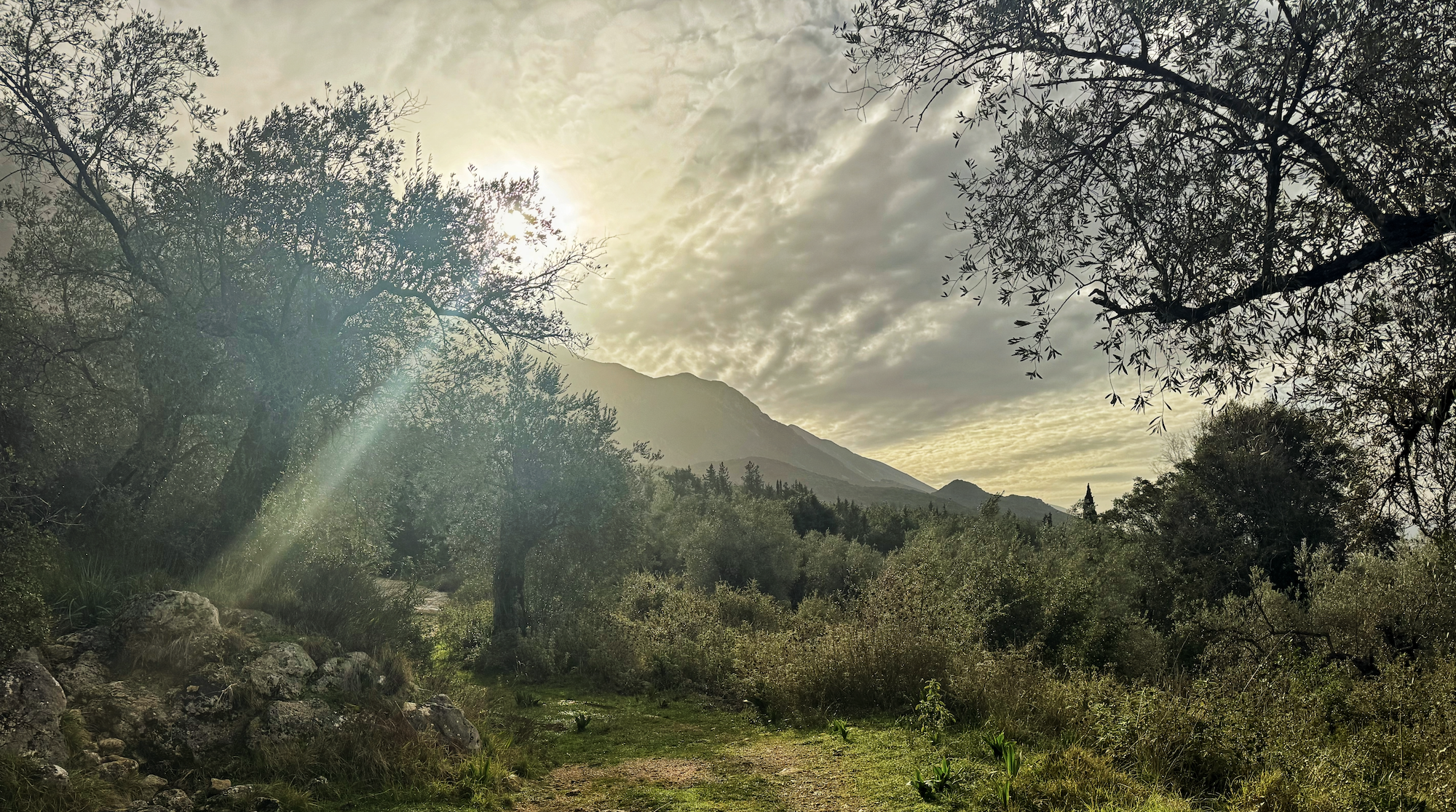
Olive-Grove in my Home Village of Zervochori
.. . .. .. . .. .. . ..
Kalimera dear friends,
A couple of weeks ago I had the pleasure of exploring Greece with my partner. Some of you may know that I am of Greek descent. My parents moved to Germany almost 50 years ago, and although I was born and raised here, I have always carried a deep connection to my ancestral motherland.
This connection, however, was not always easy. As a second-generation migrant, questions of identity and belonging shaped much of my early life. As a child, I longed to be seen and accepted as German, often feeling that my Greek heritage stood in the way. I remember feeling ashamed of my last name when it was mispronounced, or uncomfortable when people complimented me on “speaking German so well.” There was a time when distancing myself from my roots felt necessary — first to belong, and later to discover who I was and what kind of life I wanted to live.
In hindsight, that detachment seems like an essential part of my evolution. Only in recent years have I begun to rediscover a genuine appreciation for my ancestral heritage. I started to see the beauty of the Greek landscape — the thousand shades of blue in the sea, the vastness of the mountains, the vivid aliveness of its flora. I began to recognise the wisdom in the slowness and spaciousness of village life, the openness and hospitality of the people, the depth of traditional music, and the richness of Greek cuisine.
This journey, once again, fills me with gratitude for the complexity, resilience, and ancient depth of this land — and for the threads that quietly connect my own life to its long unfolding history.
.. . .. .. . .. .. . ..
Whispers of Wisdom
“Your identity is not equivalent to your biography. What often happens is that people reduce identity to biography … But, in actual fact, your identity is infinitely more complex, nuanced, sophisticated, and mysterious than your biography. There is a place in you where you have never been wounded, where there is still a sureness in you, where there’s a seamlessness in you, and where there is a confidence and tranquility in you. The intention of prayer and spirituality and love is, now and again, to visit that inner kind of sanctuary.”
— John O’Donohue
Our biographies tell the story of where we were born, how we were raised, and what shaped us. Yet identity reaches far beyond circumstance. It carries echoes of generations before us — their struggles, migrations, losses, loves, and strengths.
To reconnect with our roots is not to become confined by them. It is to recognise that within us lives something older and more spacious than any single chapter of our personal story. Beneath inherited narratives — pride or shame, belonging or exclusion — there remains an inner sanctuary untouched by history. Returning to that place allows us to honour our lineage without being defined solely by it.
.. . .. .. . .. .. . ..
Pause for Presence: The Ancestral Breath
Find a comfortable seated position. Let your spine be upright, yet at ease.
Begin with a slow rhythmic breath: inhale for 4 counts, exhale for 6 counts. Allow the longer exhale to soften your body and create a sense of spaciousness.
As you continue this breathing pattern, bring to mind your parents. Sense them not only as roles in your life, but as human beings shaped by their own stories. Acknowledge both the gifts and the burdens they carried.
Gradually widen the circle. Imagine your grandparents, and then the generations before them — known and unknown. Picture a long line of lives standing behind you. Some you may feel close to, others distant or mysterious.
With each inhale, imagine drawing in the strength, resilience, and wisdom of this lineage.
With each exhale, allow any inherited weight or unresolved tension to gently release into the earth beneath you.
Stay here for several breaths. Notice what arises in your body — warmth, resistance, gratitude, grief, neutrality. There is no right experience, but simply witnessing.
When you are ready, sense yourself as the living continuation of this lineage — shaped by it, yet uniquely your own.
.. . .. .. . .. .. . ..
Pulse of Practice: Shoulders of Support
The saying “standing on the shoulders of those who came before us” captures the essence of our ancestral roots and how what came before us continues to influence our lives. Our shoulders are structures of support — they carry weight, allow us to reach forward, draw back, rise, and soften. Over time, they can also hold unspoken responsibility, expectation, or protection.
Stand upright with your feet grounded and your spine at ease.
Up – Support
Slowly lift both shoulders toward your ears. Intensify gently for 3–5 seconds. Feel the muscular activation and structure of support as you hold.
Then release slowly, as gradually as possible, allowing the shoulders to descend back to neutral. Move with control, actively working against gravity. Pause and sense the shoulders in this resting position.
Down – Weight
Press the shoulders actively downward, lengthening the neck. Feel the deliberate effort and weight actively pulling down towards the ground, connecting you more deeply with the earth beneath you. Then slowly release the contraction over several seconds, returning to neutral. Notice the contrast between engagement and ease.
Forward – Protection
Draw the shoulders forward, slightly rounding the upper back. Sense the protective quality of this gesture. Hold and feel the activation across your chest and upper back. Slowly release and allow your chest to widen naturally.
Back – Trust
Gently draw the shoulders back, broadening across the collarbones. Embody this upright, open posture as you hold the activation, tapping into the trust to receive whatever life has to offer.
With control, slowly release and return to neutral.
Stand quietly for a few breaths. Notice how your shoulders now rest on your frame — supported, balanced, and at ease.
.. . .. .. . .. .. . ..
Resting in Reflection
What feels alive in you when you reflect on identity, connection, and belonging?
How does your ancestral history shape and colour the way you move through this life?
In what ways can you consciously keep an appreciation for your roots and origins as a living source of depth and strength alive?
.. . .. .. . .. .. . ..
Thank you for taking the time to read and for your continued interest in this work — if you’d like to explore further, you can find more information about my weekly classes and 1:1 offerings by clicking the button below.